Website · TKS Iterate
ORBIT
AI Agent Orchestration Platform
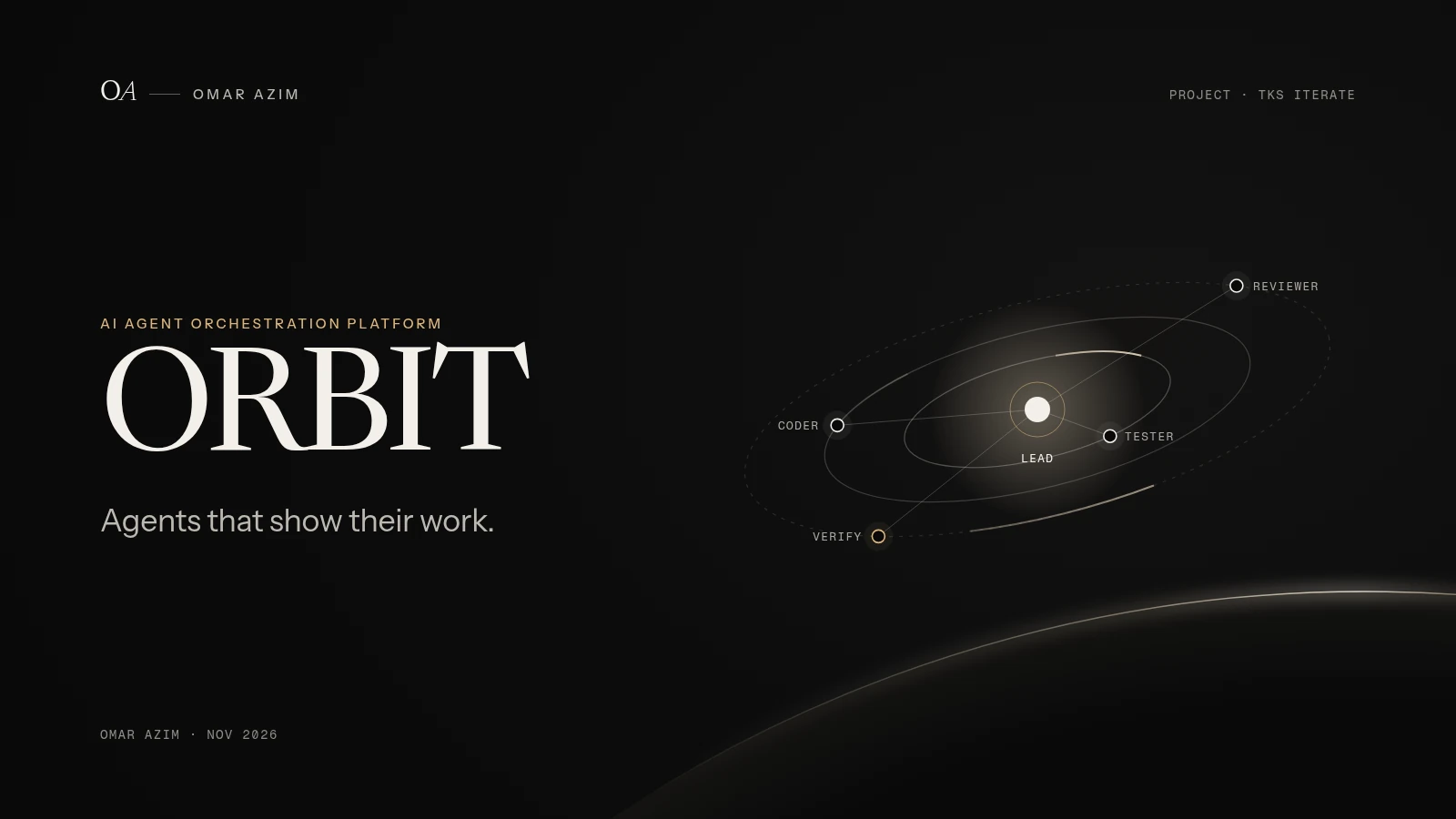
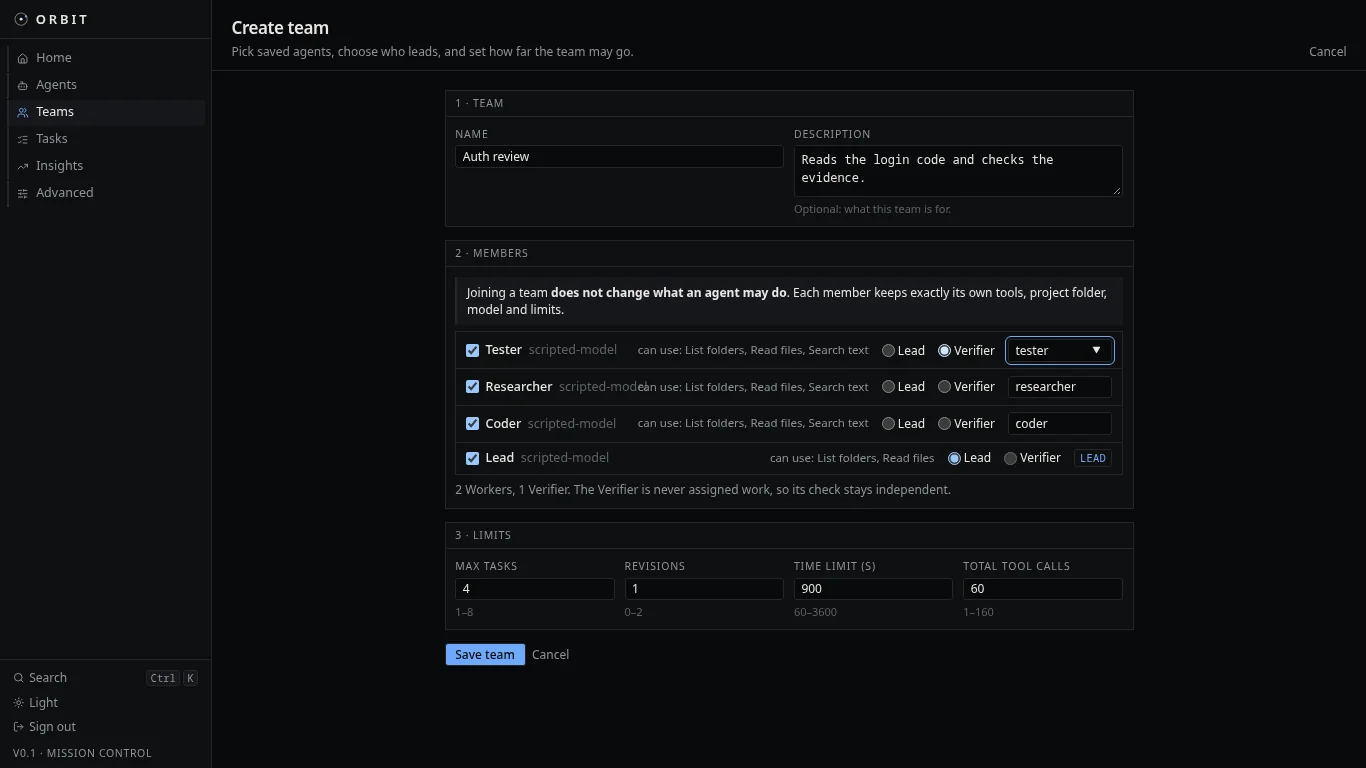
ORBIT brings multiple AI agents together in one place, allowing users to configure agents, organize them into teams, assign tasks, and monitor their execution through visual workflows.
The problem
My goal was to explore how agentic AI systems can become more transparent, manageable, and accessible, especially when multiple specialized agents need to work together.
I built ORBIT for my TKS Iterate project.
How it works
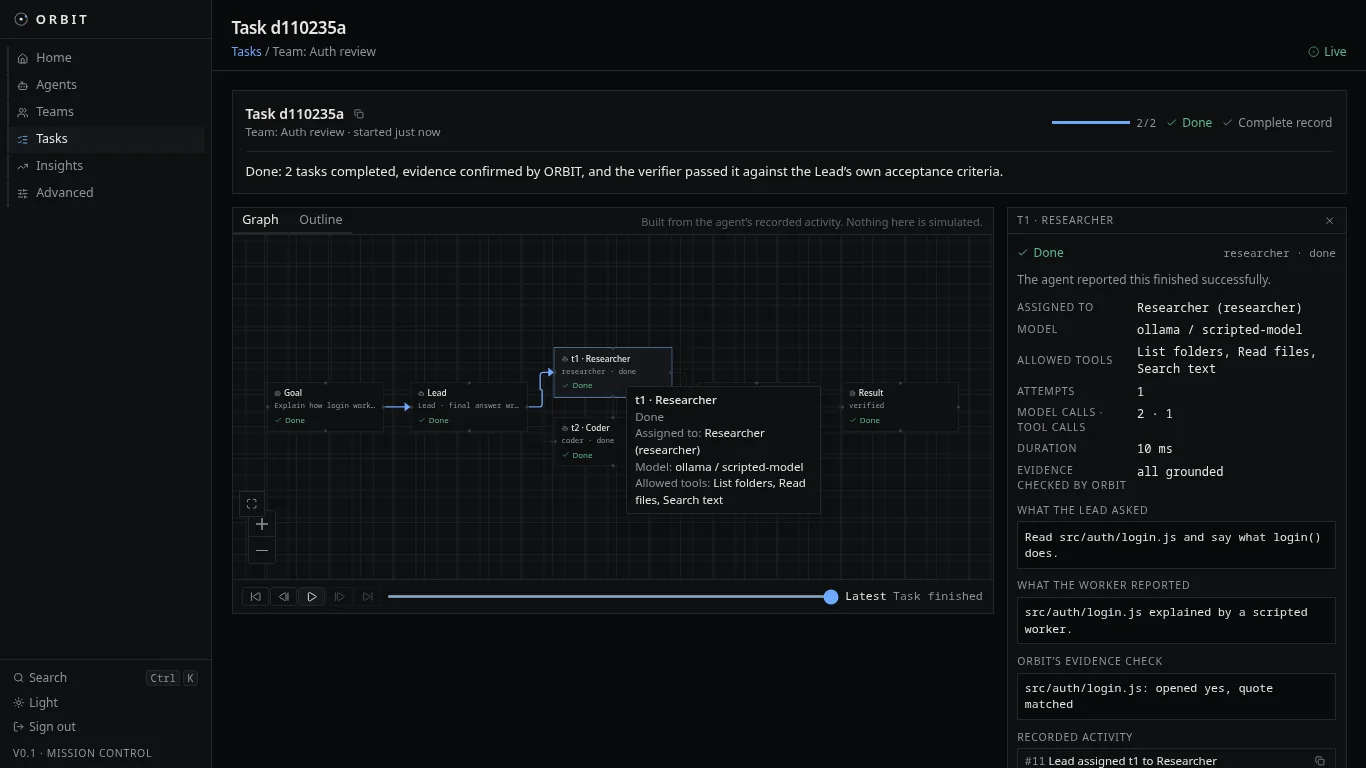
- Teams of a Lead, workers and an optional Verifier run a bounded workflow. Every model call, tool call, delegation and verdict is recorded.
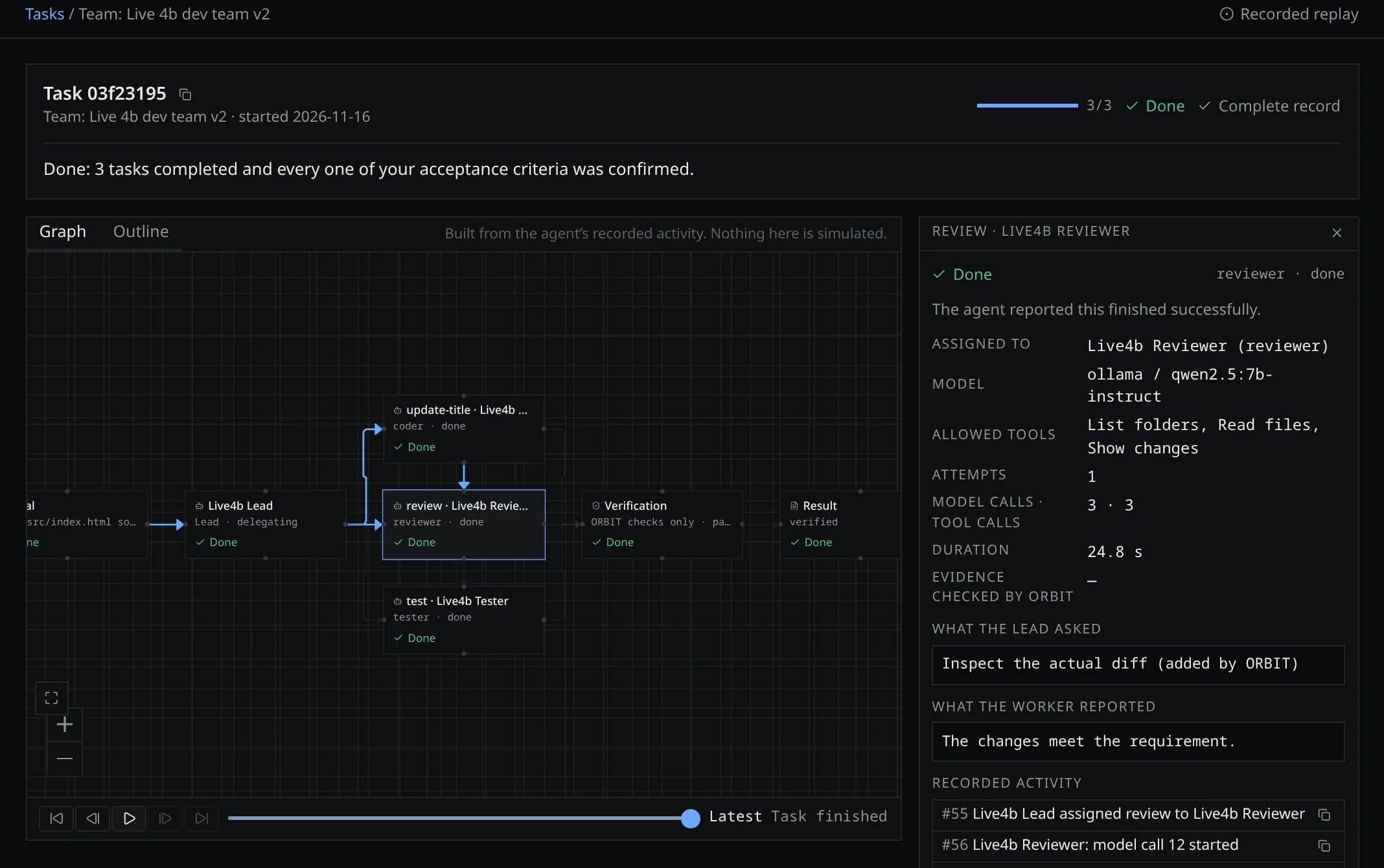
- The execution graph is built from what the agents actually reported. Nothing shown is simulated.
- Your acceptance criteria are kept apart from the Lead’s plan and checked by code. A result is only labelled Verified when they pass.
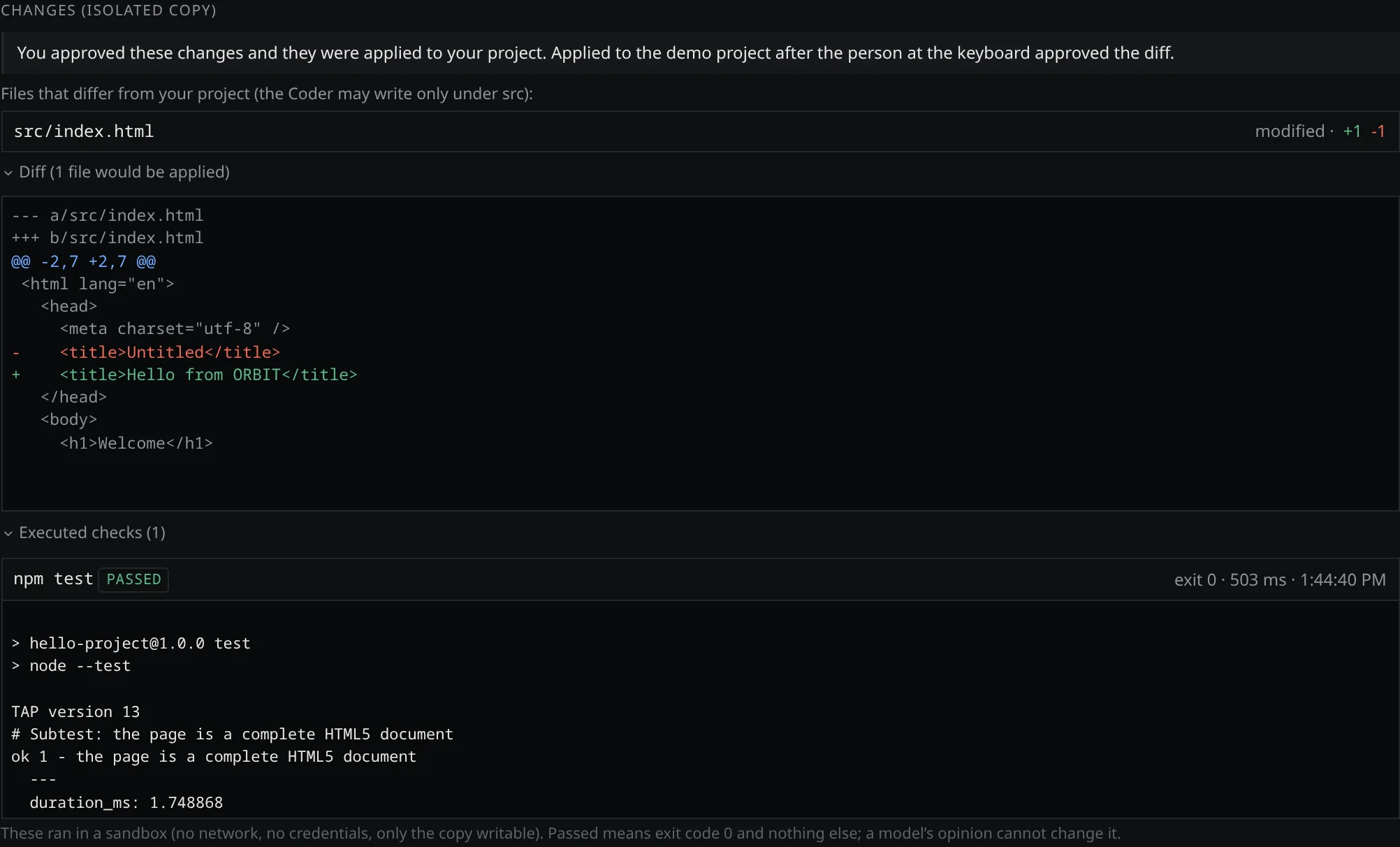
- For coding tasks, agents work in an isolated copy of the project, run approved checks in a sandbox with no network and no credentials, and wait for your approval before anything is applied.
One recorded run
- 0.0 s
Task
YouThe task and its acceptance criteria, exactly as submitted.
- 0.0–18.0 s
Plan
LeadBreaks the goal into steps. ORBIT adds the review and the checks itself, so no agent can skip them.
- 18.0–58.7 s
Execute
CoderEdits an isolated copy and shows its diff.
- 58.7–83.5 s
Review
ReviewerOpens and inspects the diff. Verdict: approve.
- 83.5–105.3 s
Verify
ORBIT + Testernpm test in a sandbox, exit 0 in 503 ms. Both criteria met.
- 105.3–115.6 s
Approve
YouA person decides what is applied.
Run 03f23195, recorded 16 November 2026. Timings are from the record.
What I discovered
On one fixture and one model, a single agent was more reliable than a team. The sample is tiny, so it isn’t a general claim, but it’s documented rather than hidden.
Small local models often can’t lead a team: planning times out, or tool calls come back written as text. ORBIT reports that instead of covering it up.
On a CPU-only laptop, local inference is the bottleneck. The proven run used the integrated GPU, where twelve model calls took about two minutes.
Screens
Where it stands
ORBIT is still evolving, and I’m continuing to improve its reliability, usability, and capabilities.
Today it’s a local, single-user MVP. The public site is a read-only replay of one recorded run.